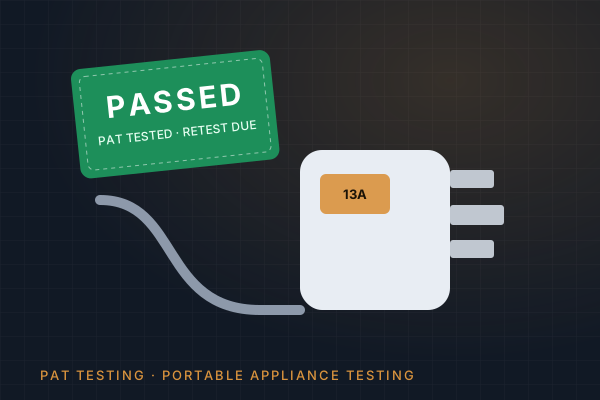
PAT testing — Portable Appliance Testing — is the routine inspection and testing of electrical equipment to make sure it is safe to use. Most electrical faults in portable equipment can be found by a careful visual inspection, and the rest by electrical testing. CIO Inspection provides PAT testing for businesses, workshops, offices and landlords, based in Southend-on-Sea, Essex.
Is PAT testing a legal requirement?
UK law does not specifically say "PAT testing" is mandatory. However, the Electricity at Work Regulations 1989 require employers to maintain electrical equipment so that it does not cause danger, and the Health and Safety at Work Act places a general duty of care on employers and those in control of premises. Landlords also have a duty to ensure electrical equipment they provide is safe. A documented programme of inspection and testing is the most practical way to meet these duties and to show that you have done so — and insurers often expect it.
Which equipment needs testing?
Any electrical equipment that connects to the mains with a plug and lead, including:
- Portable equipment: kettles, heaters, fans, power tools
- Movable equipment: printers, vacuum cleaners, small machines
- IT equipment: computers, monitors, chargers
- Stationary and fixed-but-plugged equipment: fridges, washing machines, vending machines
- Extension leads, multi-way adaptors and cable reels
Appliance classes
| Class | Protection | Typical tests |
|---|---|---|
| Class I | Basic insulation plus protective earth | Visual, earth continuity, insulation resistance |
| Class II | Double or reinforced insulation (no earth) | Visual, insulation resistance / leakage |
| Class III | Extra-low voltage supply | Visual inspection of equipment and charger |
What does a PAT test include?
- User checks — simple checks that staff can do before use.
- Formal visual inspection — the plug, fuse rating, cable, cable grip and casing are examined for damage, overheating and incorrect repairs.
- Combined inspection and testing — earth continuity, insulation resistance and, where appropriate, protective-conductor and touch-current (leakage) tests, plus a functional check.
- Labelling and records — each item receives a pass or fail label, and results are recorded in an asset register.
Testing follows the guidance of the IET Code of Practice for In-service Inspection and Testing of Electrical Equipment.
How often should appliances be tested?
There is no single fixed interval. Frequency should be based on risk — the type of equipment, how it is used and the environment. As a general guide:
- Construction sites and workshops — frequent inspection and testing, as equipment is used hard
- Industrial and commercial kitchens — more often than offices
- Offices, shops and hotels — less frequent testing for low-risk IT and office equipment
- Rented properties — commonly at each change of tenancy
The most important part of PAT is the visual inspection. Damaged cables, wrong fuses and cracked plugs account for a large share of faults found.
What you receive
- Pass/fail labels on every tested item
- A full asset register with test results
- A list of failed items with the reason and recommended action
- A recommended re-test date for each item
For fixed installations, motors and machinery, see The Importance of Electrical Quality Inspection.
Written by Abbas Ozden, CIO Inspection Ltd — quality control and inspection, Southend-on-Sea, Essex, United Kingdom.